

I recently joined Google as Head of Market Innovation on the Advanced Energy team, based in the Bay Area, where I’ll focus on identifying and advancing innovations to better enable electricity markets to accommodate AI-driven demand and clean energy technologies. (I’m grateful to TIME for profiling this development here.)
One of the things that drew me to Google is the company’s deep engagement in and support for advanced energy technology innovation, market design research, and policy development. I’ll be continuing my own PhD research and staying close to the research community, and hope to share periodic updates here on our work, even if I’m not able to post very often.
In this spirit, I’m excited to share significant new research supported by our team on how large load flexibility can improve affordability, accelerate speed to power, and preserve reliability.
A new paper released yesterday, “Flexible Data Centers: A Faster, More Affordable Path to Power,” is the first publicly available study to combine real utility transmission system data, system-level capacity expansion modeling, and site-level capacity optimization to evaluate how flexibility can accelerate data center interconnections. The study was conducted by Camus Energy (led by Astrid Atkinson), Princeton University ZERO Lab (led by Jesse Jenkins), and encoord.
The findings are compelling. Specifically, the study found that combining flexible grid connections with a “bring-your-own-capacity” (BYOC) model in the country’s largest electricity market (PJM) can:
Protect affordability: Flexible data centers contributed ~$733 million per gigawatt toward the costs associated with their incremental load, reducing net system cost increase by 96% compared to a scenario with the same volume of inflexible data centers.
Preserve reliability: Grid power remained available for >99% of hours across all modeled data center sites, with on-site resources dispatched only 40-70 hours annually.
Accelerate interconnection: This approach shortened the wait for grid power by 3 to 5 years compared to traditional timelines.
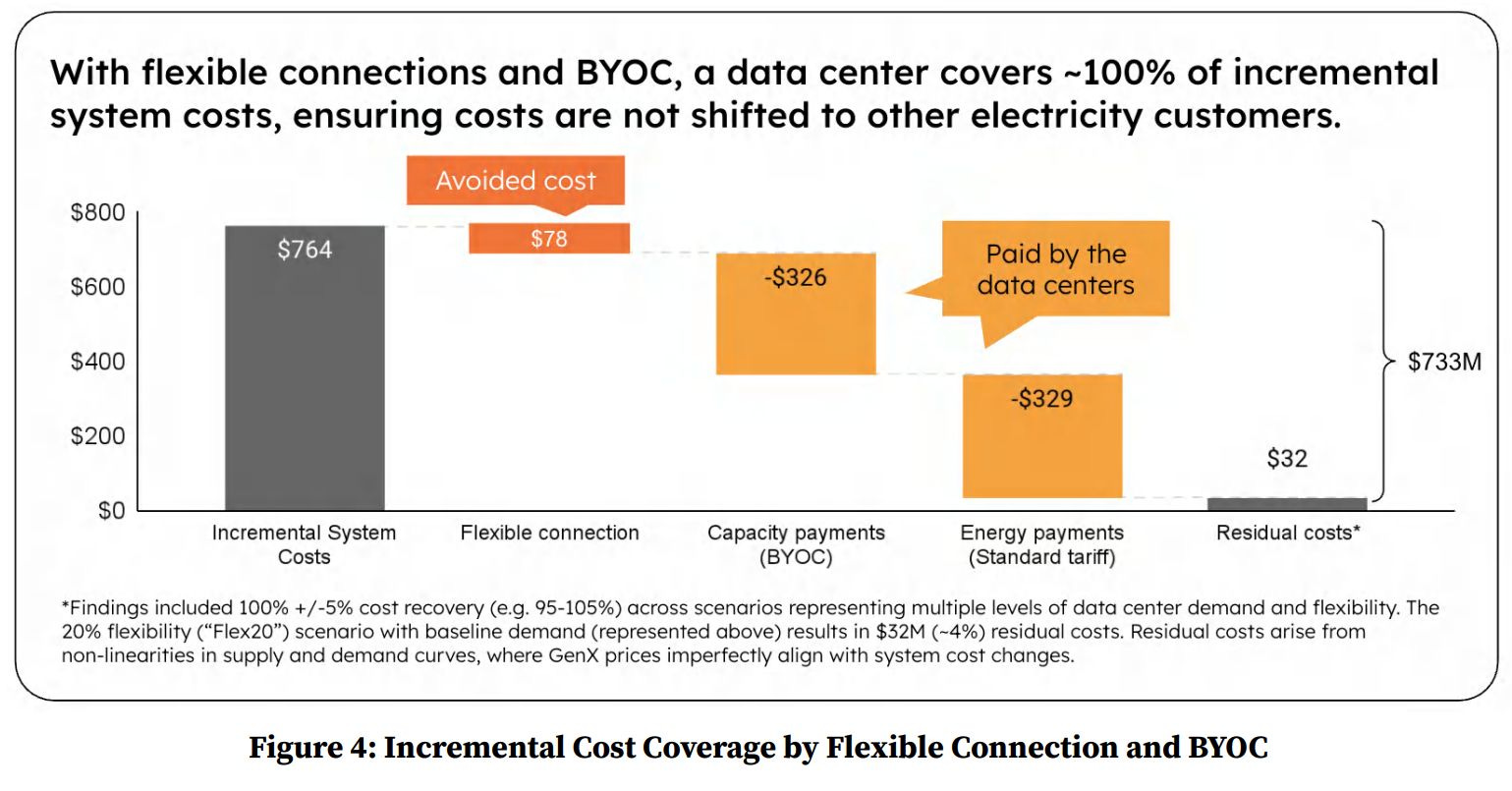
In many ways, this serves as a deeper, transmission-aware complement to our Duke University study from earlier this year, this time using a PJM-area utility’s actual transmission SCADA data and network models to evaluate not just generation constraints, but local transmission constraints as well. (For a cliffnotes version, Bloomberg, UtilityDive, and Data Center Richness covered the study yesterday.)
The conversation continues next week, when new modeling on large load flexibility in PJM by Duke University’s GRACE Lab (led by Prof. Dalia Patiño-Echeverri) will be presented in a webinar, alongside insights from EPRI, a former FERC commissioner, and a Google demand response expert (Tues, Dec. 9, 11am-12pm ET).

I hope you find this work valuable and look forward to ongoing collaboration with many of you in 2026!