

ERCOT’s “connect and manage” model has moved non-firm generator interconnection to the center of national reform debates – most recently with U.S. Senator Martin Heinrich’s July 16 introduction of the Grid Connection and Congestion Management Act. Senator Heinrich is the Ranking Member of the Senate Energy and Natural Resources Committee.
The bill (see release, bill text) seeks to address the fact that most U.S. grid operators do not currently offer a true non-firm option for generators to access the grid, along the lines of what ERCOT offers. To resolve this, the bill would require RTOs and ISOs to offer “basic access service for energy-only delivery” (BASED).
To understand this, it’s important to recall that unlike ERCOT – which offers a single, non-firm interconnection pathway – the rest of the country operates under a bifurcated framework. As required by FERC, transmission providers (i.e., ISO/RTOs and utilities) must offer a firm Network Resource Interconnection Service (NRIS) and a nominally non-firm alternative, Energy Resource Interconnection Service (ERIS).
On paper, then, a non-firm, “energy-only” pathway already exists across most of the country. Which raises an obvious question, one that has gone largely unexamined for two decades: has it worked?
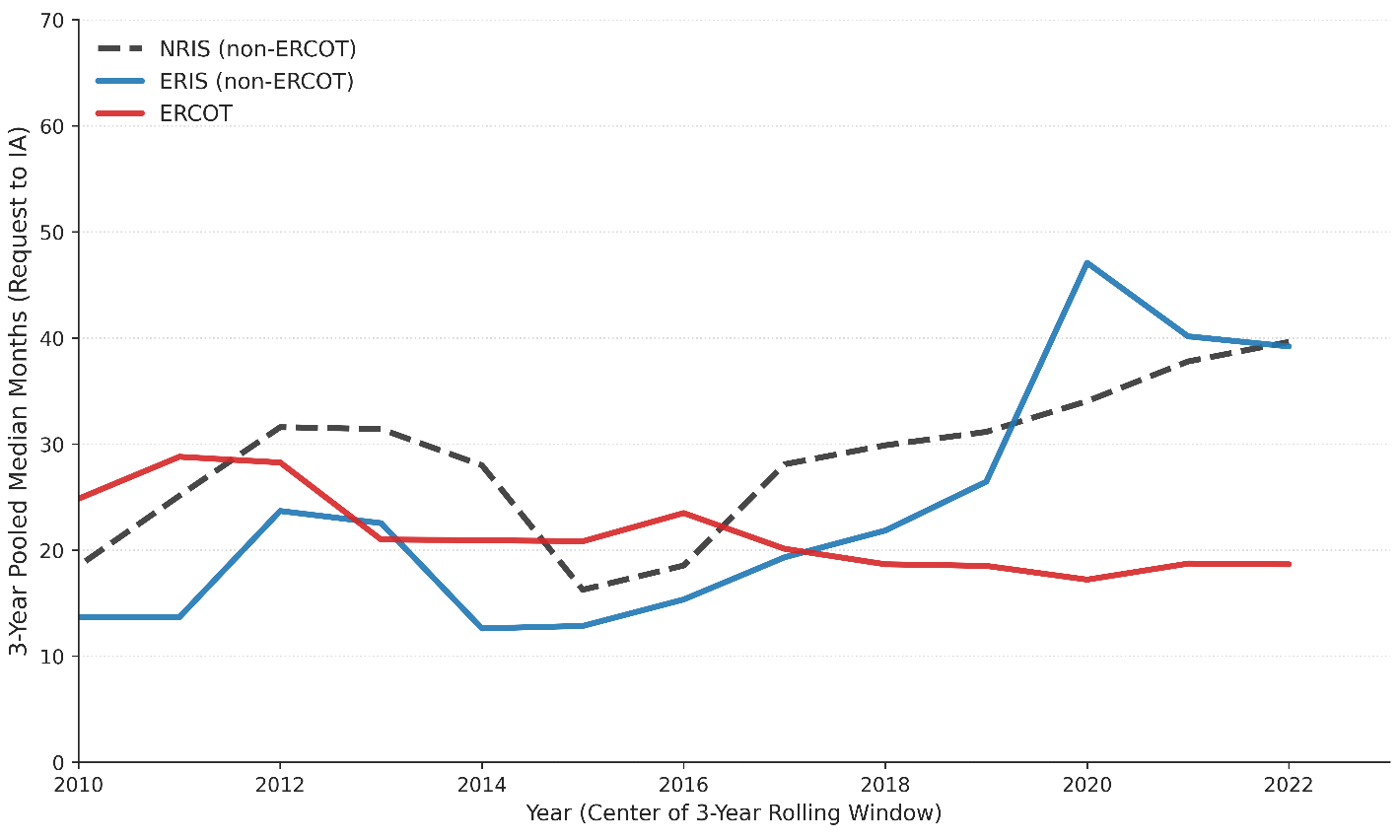
Figure: Historical Evolution of Interconnection Study Durations (2010–2022).
Understanding energy-only interconnection
That’s the question my co-authors and I set out to answer in two new companion preprints, written in my capacity at Duke University with Dalia Patiño-Echeverri, Will Gorman, Fredrich Kahrl, Joachim Seel, and Joseph Rand. Together, the papers pair the first statistically robust empirical comparison of ERIS and NRIS outcomes with a systematic review of how ERIS is implemented across the country. Both are preprints currently under journal review.
📄 Paper 1: Is Energy-Only Interconnection Working? Empirical Evidence from Two Decades of U.S. Market Data
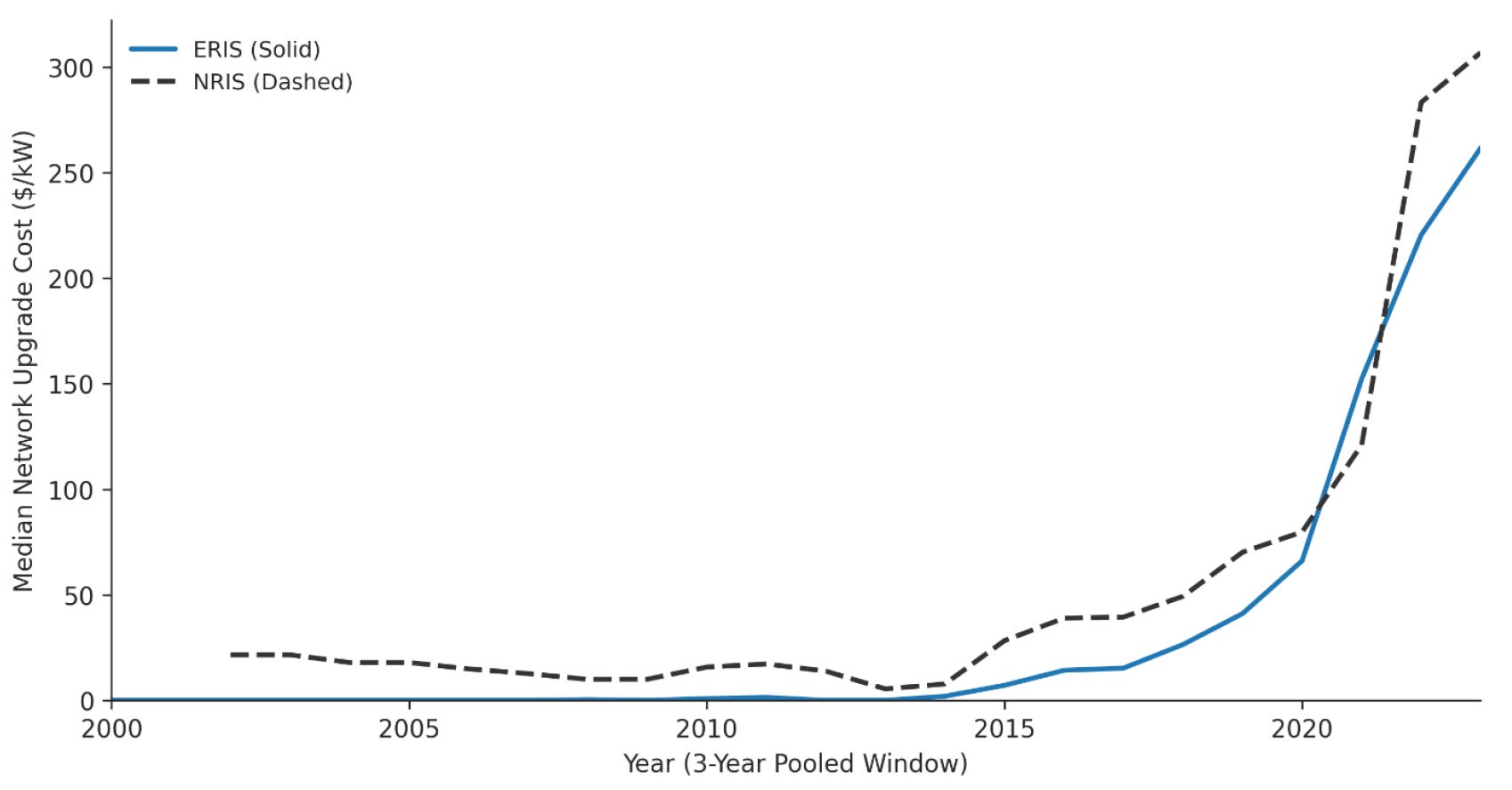
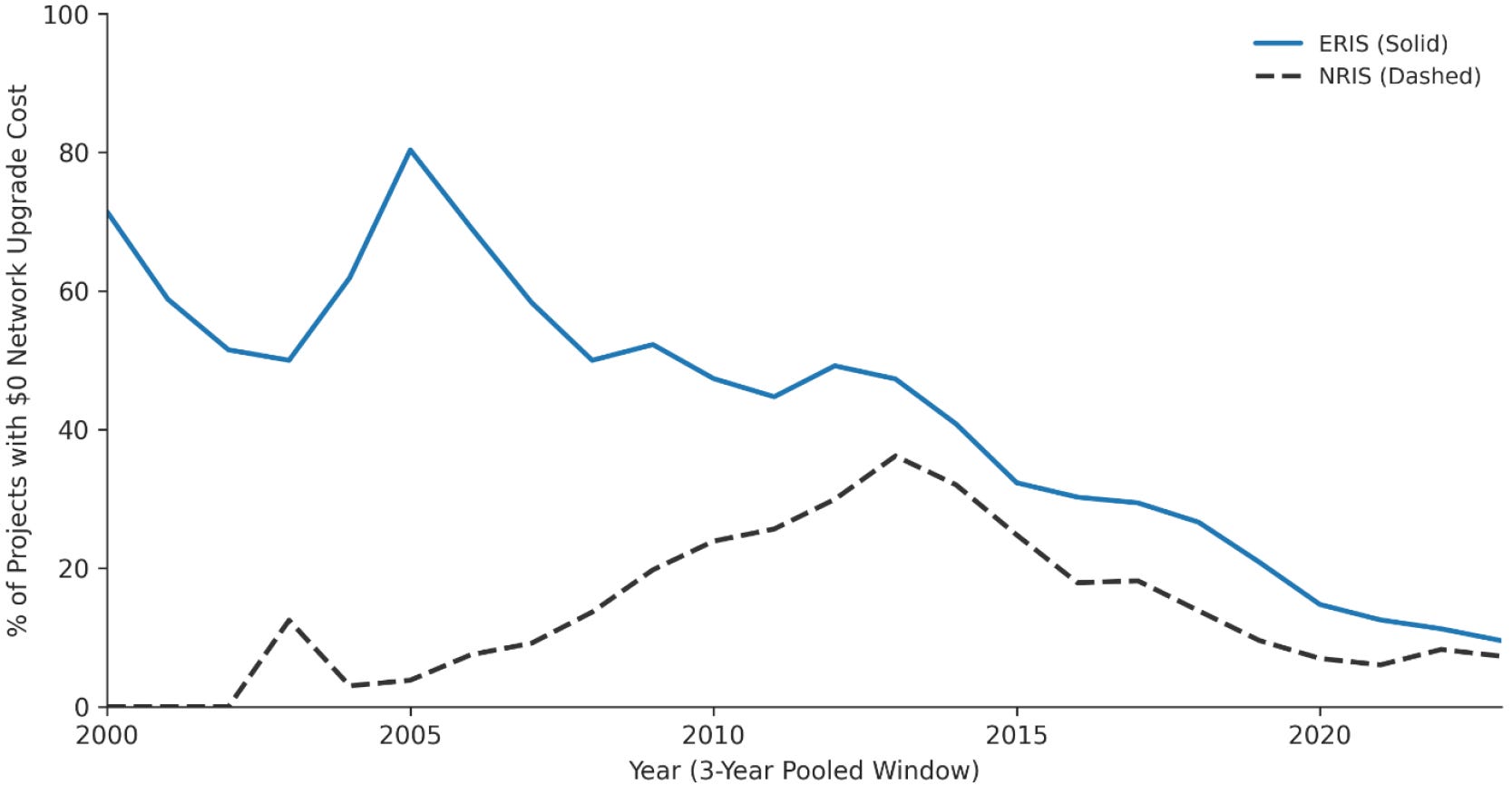
Drawing on a novel dataset of over 4,500 interconnection cost studies and 36,000 interconnection requests, we find that ERIS has not delivered a durable cost or speed advantage. Its historical cost advantage is largely a “threshold effect” that appears only when a project avoids network upgrades altogether. Once physical upgrades are triggered, ERIS and NRIS face statistically comparable costs.
Figure: Historical Trend in Median Network Upgrade Costs by Service Type (2000-2023).
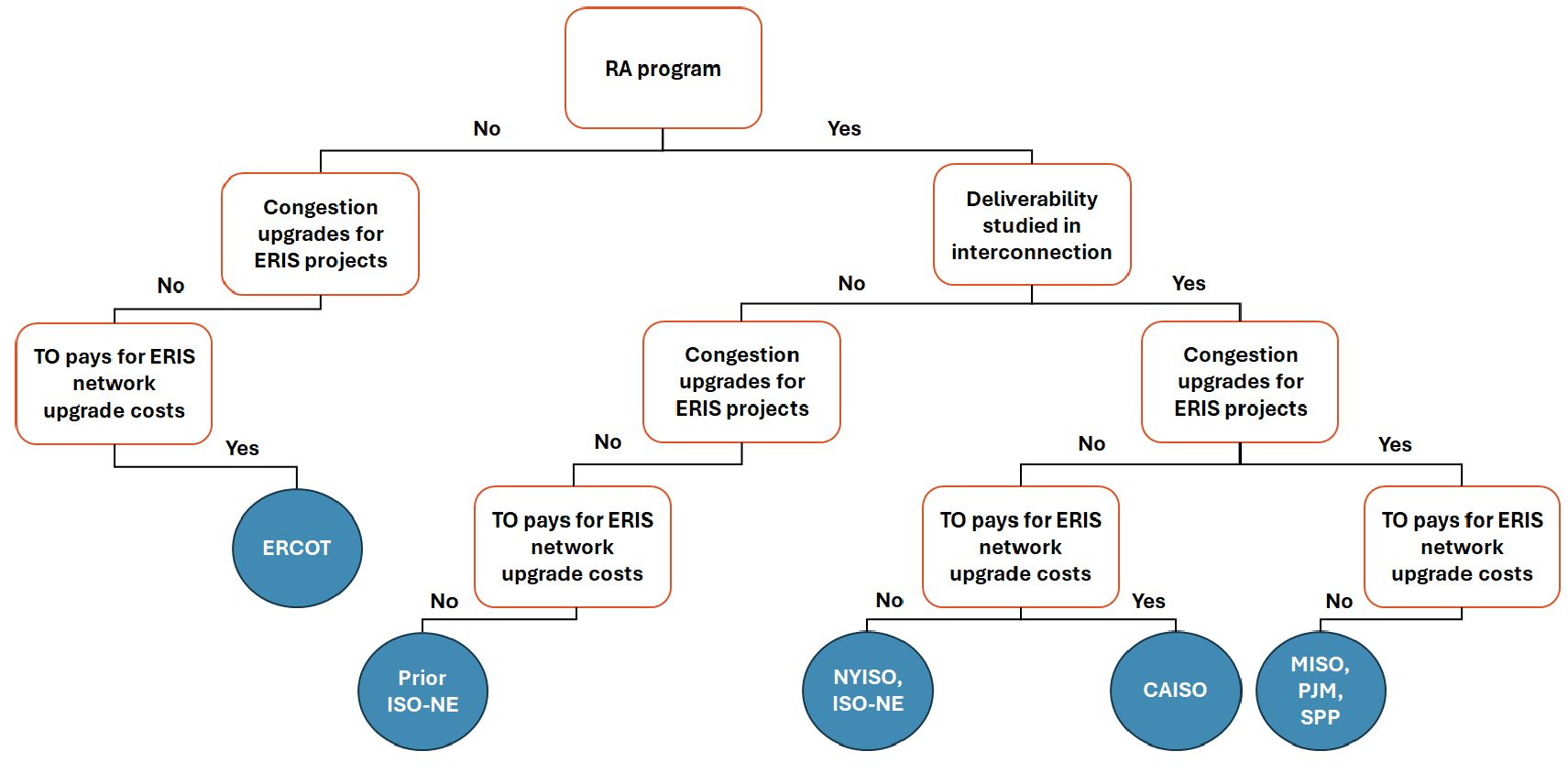
Reviewing six ISOs and three major vertically integrated utilities, we document wide and often poorly understood variation in study methods, cost allocation, and procurement rules, showing how regions range from managing congestion through real-time operations to triggering network upgrades during interconnection.
Notably, both papers conclude that the issue is not the concept of energy-only interconnection – which remains economically sound – but how it has been implemented: restrictive study assumptions that require upgrades for congestion that could instead be handled through operational redispatch.
Figure: Key ERIS Design Points and Different Approaches by Market Region
Where the bill aligns with the evidence
To be clear, our papers were completed independently of the legislation. They do not evaluate the bill, and this post should not be read as an endorsement of its broader legislative merits. The narrower technical observation is that several of the bill’s provisions address the same design issues identified in the research.
1. Operational management before capital upgrades
A central finding of our research is that ERIS’s underperformance appears to stem in significant part from study methodologies that trigger network upgrades for congestion that real-time markets could manage through redispatch. The bill addresses this directly: evaluations “shall assume that a constraint identified in the evaluation will be managed through operational measures, including redispatch, curtailment, operating limits, and remedial action schemes,” and may identify upgrades “only to the extent that operational measures cannot maintain compliance with applicable reliability standards” (§224(d)(4)). This is essentially the “minimum interconnection” approach already practiced in CAISO, ISO-NE, and NYISO, which our companion paper describes as the reform benchmark.
Figure: Share of Projects with Zero Network Upgrade Costs by Service Type (2000-2023).
2. Separating deliverability from basic interconnection
One mechanism that may help explain the convergence between ERIS and NRIS is that some operators subject non-firm requests to deliverability or congestion-impact screens that can trigger upgrades inconsistent with a genuinely as-available service. The bill would prohibit using the BASED evaluation to identify upgrades for the purpose of enabling deliverability or preventing congestion-related curtailment (§224(d)(3)), and would limit cost responsibility accordingly (§224(f)(2)). Our cost dataset does not identify the purpose of each assigned upgrade, so the empirical paper cannot isolate this mechanism directly. Read together with the regulatory review, however, the provision addresses a plausible source of the convergence we observe.
3. Protecting a distinct study track
Our duration data tell a cautionary story here. ERIS still reaches an interconnection agreement faster than NRIS (a median of 24 versus 31 months), but that advantage has eroded sharply: study durations for both services in non-ERCOT regions have more than doubled since 2009, with ERIS durations spiking to 47 months around 2020 as the two tracks converged. Our paper suggests this convergence is likely to be reinforced by the transition to cluster-based studies under FERC Order No. 2023 — because ERIS requests are now routinely evaluated alongside NRIS requests, they inherit similar restudy risks, shared upgrade dependencies, and administrative bottlenecks. Section 224(h) responds by letting an energy-only customer "elect to have the evaluation... conducted independently of any grouped study process, such as a cluster study," and prohibits RTOs from conditioning or delaying the service pending any grouped process. In effect, it insulates the streamlined study from the shared restudy and upgrade dependencies that have eroded the distinction between the two services. Whether an independent track can deliver ERCOT-like timelines is an open empirical question, but the provision targets the one stage where the data show a genuine, if eroding, ERIS advantage worth preserving.
Why non-firm interconnection matters beyond the queue
The broader case for enabling non-firm interconnection is not simply that it may reduce grid connection timelines. It matters because full deliverability is not necessarily the least-cost product for every megawatt; because emerging generation, storage, and large-load configurations increasingly strain the binary distinction between “deliverable” and “not deliverable”; and because a well-designed as-available pathway can improve both the use of existing transmission and decisions about where to expand it.
More efficient use of existing transmission. When a constraint binds only during limited hours or under limited system conditions, the cost of eliminating all prospective curtailment can exceed the value of the energy that would otherwise be curtailed. A credible as-available option can increase transmission utilization, reduce barriers to entry, and allow new supply to begin serving the market while longer-term transmission needs are evaluated.
Non-firm interconnection and proactive transmission planning are complementary. A genuine non-firm pathway can reduce reliance on the interconnection queue as a piecemeal transmission-planning process, while persistent congestion, curtailment, and nodal price differences provide evidence about where expansion may be most valuable. By letting resources connect and tolerating congestion as an operational feature, it can free planners to identify and prioritize the highest-value network upgrades through regional planning processes — and the congestion itself supplies the evidence, since nodal price separation quantifies where transmission investment yields the greatest benefit. I made this case in testimony to FERC's 2024 generator interconnection workshop, as did Joshua Rhodes and Michael Webber in a paper released this month, noting that tolerating congestion "provides clear signals for where transmission investment is most valuable.”
Capacity value is not binary. A resource that lacks system-wide deliverability may still have partial or locational reliability value — for example, by serving nearby load, charging a co-located battery, or reducing flows across a constrained interface. Solar-plus-storage is a straightforward example: solar capacity above the facility’s export limit can be treated as energy-only rather than forcing the full solar nameplate through a deliverability test. Emerging large-load and co-location frameworks reflect the same principle: evaluate actual net injections and enforceable operating limits, not just a binary ERIS-or-NRIS label. Capacity accreditation remains a separate regional question, but a standardized non-firm framework would make these configurations easier to evaluate consistently.
Market design changes the value of deliverability. PJM’s May 2026 “Powering Reliability Through Market Design” white paper presents, without recommending, three possible directions for PJM. One involves a deliberate, phased shift of revenue recovery from the capacity market toward the energy and ancillary-services markets. To the extent any such shift occurs, in PJM or elsewhere, it changes the relative commercial value of paying for full deliverability.
Declining marginal capacity value points the same direction. As solar and wind penetration grows within a jurisdiction, a technology’s marginal ELCC often declines, reducing the incremental capacity value that full deliverability may unlock. This does not eliminate the value of those resources. California, for example, expects energy-only solar to become a significant part of its resource mix in the later 2030s (see slide 51 here and recording here at 1:02:20). Our companion paper’s North Carolina case study illustrates the potential mismatch between planning and procurement. After the state enacted a bipartisan decarbonization standard, capacity-expansion models selected substantial volumes of energy-only solar, while utility procurement required resources to obtain full network transmission service. That design meant full-deliverability upgrade costs could be embedded in PPA bids and ultimately recovered from ratepayers, even where planning models treated the incremental solar as energy-only. The point is not that full deliverability has no value, but that planners and buyers should compare that value with the cost of obtaining it rather than require it by default.
None of this dissolves the tradeoffs inherent to a constrained transmission system. But it suggests the stakes of getting non-firm access right extend well beyond queue mechanics — into resource adequacy accounting, market design, procurement policy, and the terms on which large new loads connect.
For two decades, the U.S. has nominally offered a non-firm interconnection option. But the aggregate evidence shows that it has not delivered a durable or generalizable cost or speed advantage. Whatever one’s view of this particular bill, the debate it opens should proceed from that empirical record. The central problem is not the economic logic of energy-only access, but whether study rules and related market institutions preserve the tradeoff the service is supposed to offer: reliable connection and as-available grid access in exchange for accepting congestion and curtailment risk.
The views expressed here are my own and do not represent the positions of my employer or any institution with which I’m affiliated. The research described was conducted in my capacity at Duke University.
Further reading
The papers and underlying data
Norris, T., Patiño-Echeverri, D., Gorman, W., Kahrl, F., Seel, J., & Rand, J. (2026). Is Energy-Only Interconnection Working? Empirical Evidence from Two Decades of US Market Data. SSRN preprint. [link]
Gorman, W., Kahrl, F., Norris, T., & Patiño-Echeverri, D. (2026). A Review of United States Energy-Only Generator Interconnection Service Policy and Considerations for Reform. Lawrence Berkeley National Laboratory. [link]
LBNL, Interconnection Cost Database and Queued Up: Interconnection Queue Data — the publicly available datasets underlying both papers.
Rand, J., et al. (2026). Queued Up: 2026 Edition — Characteristics of Power Plants Seeking Transmission Interconnection. LBNL.
The legislation
Sen. Heinrich, press release and bill materials for the Grid Connection and Congestion Management Act (July 2026), including the one-pager, section-by-section summary, and full bill text.
Robinson Meyer, “Scoop: A Key Democrat Wants to Fix the Power Grid, Texas-Style,” Heatmap News (July 16, 2026).
Interconnection reform and the ERCOT experience
Kotwis, S.T., et al. (2026). Powering New Loads and Lowering Electricity Costs with Connect-and-Manage Interconnection. RMI.
Rhodes, J. & Webber, M. (2026). The Texas Flex. GridLab.
Norris, T. (2023). Beyond FERC Order 2023: Considerations on Deep Interconnection Reform. Duke Nicholas Institute.
Norris, T. (2024). Comments for FERC Workshop on Innovations and Efficiencies in Generator Interconnection. Duke Nicholas Institute.
Gorman, W., et al. (2025). “Grid Connection Barriers to Renewable Energy Deployment in the United States.” Joule 9(2).
Silverman, A., et al. (2023). “What’s Next in Interconnection Reform? Lessons from International Experience.” Columbia Center on Global Energy Policy.
USDOE (2024). Transmission Interconnection Roadmap: Transforming Bulk Transmission Interconnection by 2035.
Economics of firm vs. non-firm access and cost allocation
Hogan, W. (1992). “Contract Networks for Electric Power Transmission.” Journal of Regulatory Economics 4(3).
Joskow, P. & Tirole, J. (2000). “Transmission Rights and Market Power on Electric Power Networks.” RAND Journal of Economics 31(3).
Mays, J. (2023). “Generator Interconnection, Network Expansion, and Energy Transition.” IEEE Transactions on Energy Markets 1(4).
Macey, J. & Mays, J. (2024). “The Law and Economics of Transmission Planning and Cost Allocation.” Energy Law Journal 45(2).
Simshauser, P. & Newbery, D. (2024). “Non-Firm vs Priority Access: On the Long Run Average and Marginal Costs of Renewables in Australia.” Energy Economics 136.
Monterde, M.R., Alvarez, E.F., & Valarezo, O. (2025). “Non-Firm Grid Connections: A Review of Access Types, Mechanisms, and Regulatory Frameworks.” Current Sustainable/Renewable Energy Reports 12(1).